 Home
Home
Home
Home
Business-class transfer — Mercedes-Benz E-Class, from €336 per car · About 1.5 hours · door-to-door with meet & greet
Agreed when you book, all taxes included — the same day and night.
Your driver waits in the arrivals hall with your name on a sign.
Counted from the actual landing — we track the flight.
A pre-booked private transfer from Helsinki Airport (HEL) to Fiskars Village is a fixed price from €336 for the whole car in the E-Class (Business sedan), up to 3 passengers — about 104 km, ~90 min. The price is fixed at any hour, agreed the moment you book. Your English-speaking driver meets you in the Terminal 2 arrivals hall; flight tracking and 60 minutes of free waiting are included. No meter, no hidden fees. You book directly with the local operator — the fleet we operate, our own drivers — and return transfers to the airport start from €336.
Prices below are starting fixed fares for the Helsinki Airport ↔ Fiskars Village route (about 103.7 km). The exact price for your specific address, date and time is calculated instantly in the booking form that opens from the Book your transfer button — and stays fixed once you book.
| Vehicle | From | |
|---|---|---|
| E-Class (Business sedan) — Mercedes-Benz E-Class, EQE or BMW 5 Series (up to 3 passengers, 3 bags) |  | €336 |
| V-Class (First class van) — Mercedes-Benz V-Class (up to 6 passengers, 6 bags) | 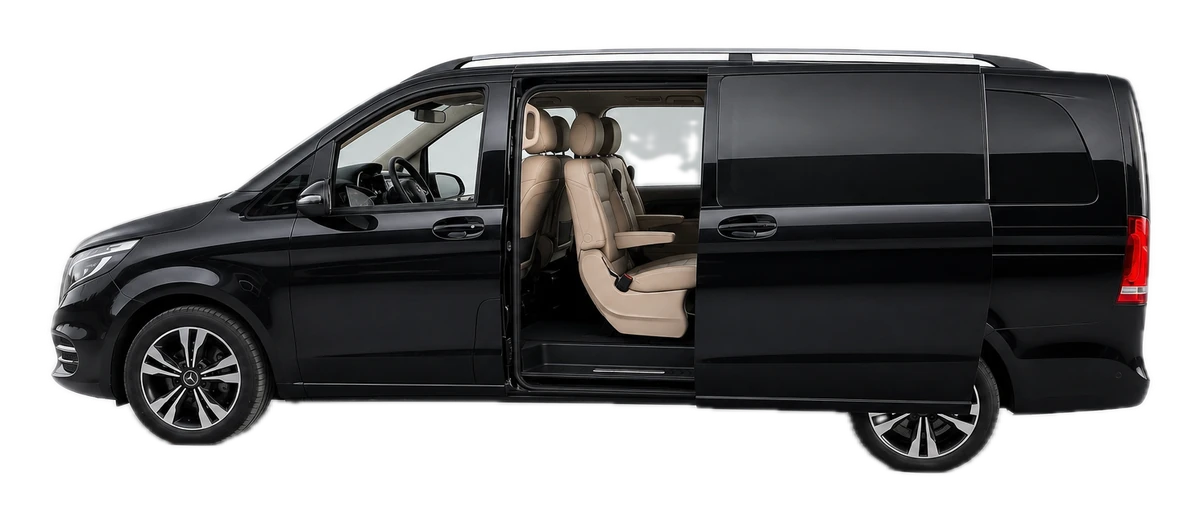 | €346 |
| S-Class (First Class) — Mercedes-Benz S-Class or EQS (up to 3 passengers, 3 bags) |  | €586 |
| Vito (Business van) — Mercedes-Benz Vito (up to 8 passengers, 8 bags) | 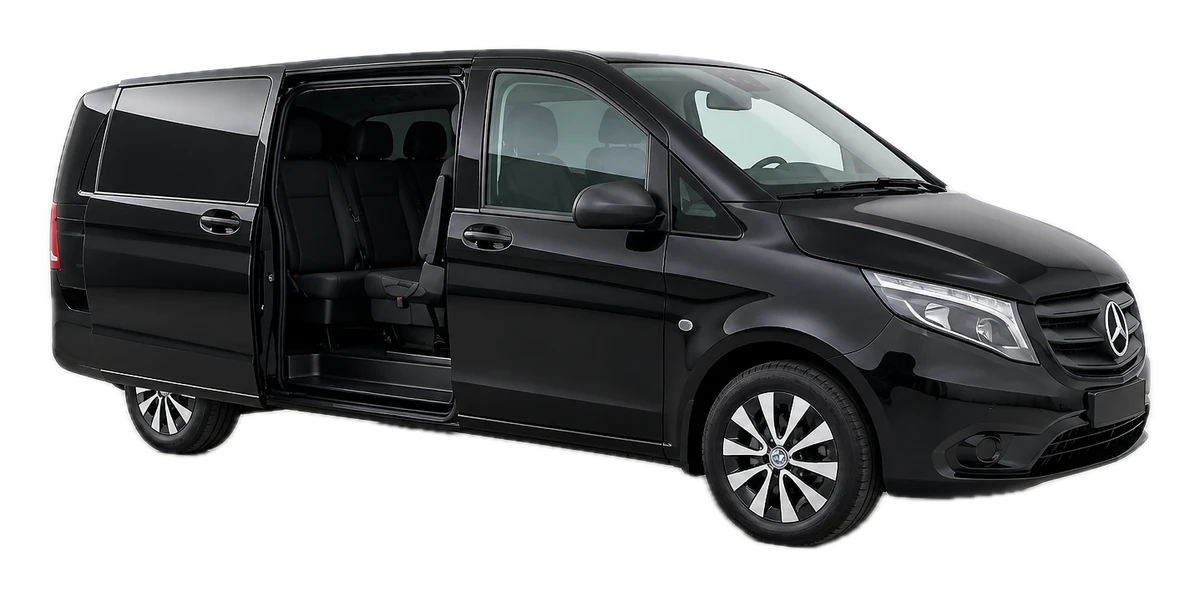 | €346 |
| Sprinter (Business minibus) — Mercedes-Benz Sprinter in business-class trim (up to 15 passengers, 15 bags) | 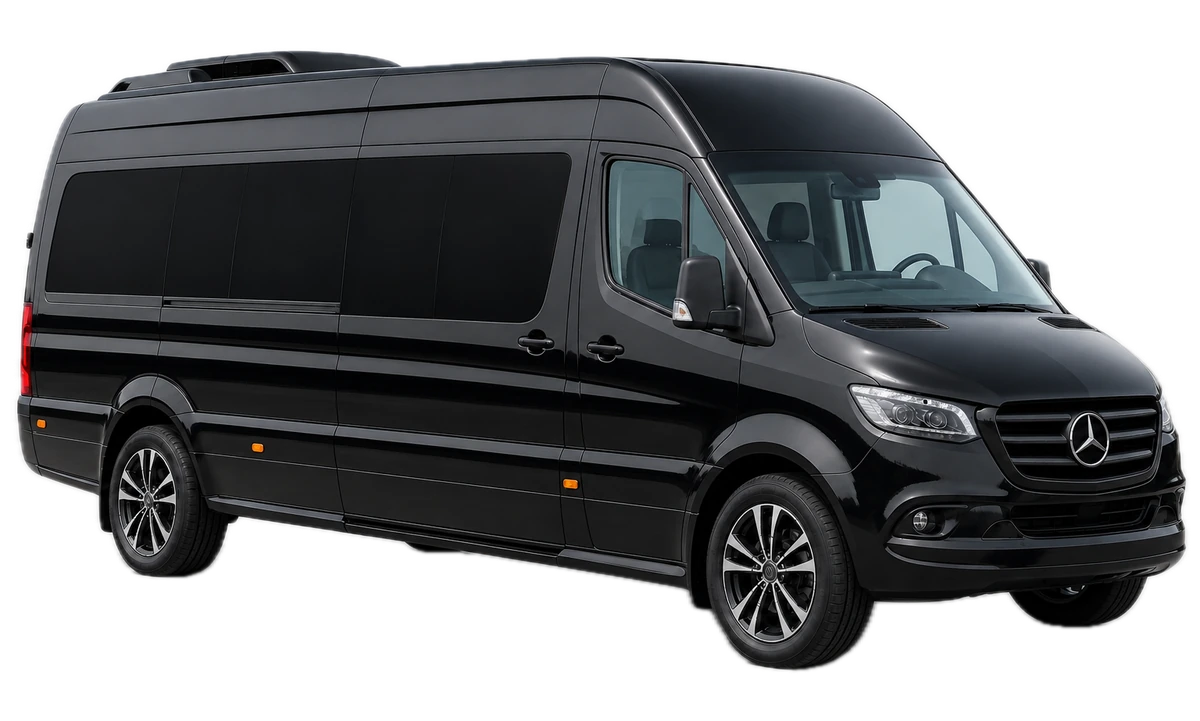 | €487 |
Travel from Helsinki Airport (HEL) directly to Fiskars Village in a private, pre-booked car with an English-speaking driver. Your driver tracks your flight, meets you in the arrivals hall with a name sign, helps with your luggage, and drives you straight to your accommodation in the village — Fiskars Wärdshus, the Torby cottages, a rented studio apartment or any address in the ironworks area — with one price agreed and fixed before you book. There is no meter, no taxi-rank negotiation for an out-of-town trip, and no train-and-bus puzzle: one car, one driver, one fixed fare from the terminal door to the village.
Fiskars Village sits in Raseborg, in the wooded river valley of western Uusimaa, about 103.7 km west of Helsinki Airport — a drive of around 1.5 hours. It is the original home of the Fiskars brand, founded as an ironworks in 1649 and today one of Finland's best-known artisan and design communities. We have been driving international travellers across southern Finland since 2008, with more than 20,000 passengers carried, and the run west to the old ironworks villages is a route our drivers know in every season.
A fixed price for a country drive. Fiskars is a rural destination roughly 103.7 km from the airport, and a metered taxi over that distance is an unpredictable and usually unpleasant number. With a pre-booked transfer the fare is calculated from the real distance and driving time, shown to you before you confirm, and never changes afterwards — whatever the traffic on the Turku motorway does that day. You know the total cost of reaching the village before your flight even takes off.
No workable public transport connection. There is no train station in Fiskars and no direct bus from the airport. The public route means a train towards Karjaa (Karis), then a thin local bus service or a country taxi for the last stretch into the village — workable for a determined backpacker, slow and awkward for anyone with suitcases, children or a schedule. A private car removes the whole chain: you land, you meet your driver, and about 1.5 hours later you are in the village.
Door to door with your luggage handled. Every transfer is address to address, not a shuttle stop. Your driver carries your bags at the terminal, loads them for you, and drops you at the door of Fiskars Wärdshus, your cottage or your studio — useful in a village where accommodation is scattered along the river valley rather than clustered around a single hotel entrance.
Flight tracking and free waiting time. We monitor your flight in real time, so if you land early or late the pickup adjusts automatically. Up to 60 minutes of free waiting time after landing is included in every fare, which is enough for passport control, baggage and a coffee — your driver is in the arrivals hall with a name sign whenever you walk through.
Room for antiques and studio finds. Fiskars is a place people leave with more luggage than they arrived with — ceramics, glass, knives and scissors from the Fiskars Shop, artwork from ONOMA members, finds from the antique dealers. A Vito (Business van) takes up to 8 passengers and 8 bags, and on the return leg that spare capacity is often exactly what a day of browsing the Copper Smithy and the antique barns requires.
The same service back to the airport. For the return, your driver collects you from your accommodation in Fiskars at the agreed time and drives you straight to the Helsinki-Vantaa departures door, with the same fixed pricing. If you are catching a morning flight, a confirmed car at your cottage door beats hoping a rural taxi is available at 6 a.m.
The drive from Helsinki Airport to Fiskars Village covers about 103.7 km and takes around 1.5 hours in normal conditions. Your driver takes Ring III west from the terminal, joins Highway 1 (E18), the Turku motorway, and follows it west past Espoo and through the Lohja lake district, then turns onto Route 25 towards Hanko. Near Karjaa the route leaves the main road for the smaller country roads that follow the Fiskars river valley north into the village, where the road becomes the ironworks main street itself, lined with the old brick and wooden workshops.
It is a genuinely pretty drive — motorway through forest and lake country for the first hour, then winding rural roads past fields, manor lands and the neighbouring ironworks village of Billnäs for the final stretch. There are no ferries and no toll roads, and in summer the run is smooth and quick; the only slow patch is occasionally leaving the airport area at rush hour.
In winter the final country-road section is where a professional driver earns his keep: the roads are ploughed and our cars run proper Nordic winter tyres, so snow is a scenery upgrade rather than a problem. Whatever the season, your driver handles navigation, parking and luggage, drops you at your exact address in the village, and can point you to the essentials — the Clock Tower building, the Copper Smithy, the village shop — before he leaves.
Fiskars Village is where the Fiskars company began. In 1649 the Dutch merchant Peter Thorwöste was granted the right to establish a blast furnace and forge here, in a river valley chosen for its water power and its distance-from-nothing supply of forest for charcoal. The ironworks he founded grew into what is today the oldest continuously operating private company in Finland — the same Fiskars whose orange-handled scissors, launched in 1967, sit in kitchen drawers on every continent.
For nearly three centuries the village lived entirely from iron: bar iron at first, then knives, ploughs, scissors and machinery, with the company building the workers' housing, the school, the assembly hall and the granaries that still line the main street. When production finally moved away in the 20th century, the village emptied — and then, from the early 1990s, the company began renting the old workshops and houses to artists, designers and craftspeople. That decision turned a museum-piece ironworks into a living community, and it is why Fiskars today feels worked-in rather than preserved.
For a visitor, the result is a single walkable street of 18th- and 19th-century industrial architecture — the Clock Tower building, the Copper Smithy, the granary, the rows of workers' cottages — with working studios, shops and restaurants behind almost every old door. It is regularly ranked among the most beautiful villages in Finland, and it earns the ranking.
The engine of modern Fiskars is ONOMA, the cooperative of artisans, designers and artists founded in the village in 1996 — one of the oldest working artist cooperatives in Finland, with around 145 members who all live or work in Fiskars. Between them they cover dozens of disciplines: ceramics, glass, woodwork, jewellery, textiles, furniture, blacksmithing and fine art, much of it made in the very buildings where the ironworks once forged its blades.
What this means in practice is that Fiskars is not a craft-themed shopping street but an actual production village. Many studios open their doors to visitors, the ONOMA shop in the village sells members' work year-round, and it is entirely normal to buy a bowl or a knife from the person who made it that week. For travellers interested in Finnish design beyond the Helsinki flagship stores, this is the place the designers themselves go.
If design is the main purpose of your trip, tell us — the drop-off can be set to the ONOMA shop or the Copper Smithy end of the village just as easily as to your accommodation, and on a day-trip itinerary your driver can wait while you work through the studios.
Every summer since the 1990s, Fiskars has staged one of Finland's most respected art and design exhibitions, curated by the ONOMA cooperative and housed in the Copper Smithy and the Old Granary. The show runs roughly from early June to the end of August, changes theme every year, and draws collectors, design professionals and ordinary day-trippers from across the country — it is the single busiest reason people make the trip out from Helsinki in summer.
In recent years the programme has grown into the Fiskars Village Art & Design Biennale, which spreads international-level contemporary art and design across several venues in the village through the summer season. If your visit falls between June and August, plan time for it: the Copper Smithy alone rewards a couple of unhurried hours, and the exhibition is precisely the kind of destination where arriving rested by private car, rather than after a multi-leg public transport journey, changes the quality of the day.
The Fiskars Shop in the village sells the company's full range — scissors, knives, axes, garden tools and kitchenware — alongside premium tableware brands from the wider Fiskars group, and it is a far better place to buy them than an airport gift shelf. Around it, the village's shops and studios sell ONOMA members' ceramics, glass, woodwork and jewellery, most of it made a few doors away.
Fiskars is also one of southern Finland's best-known antique destinations. Several dealers operate in the old ironworks buildings, and the village's antique fair in high summer fills the halls with dealers from around the country — furniture, glass, industrial pieces and curiosities from two centuries of Finnish homes. Serious buyers time their visit to it deliberately.
This is worth remembering when you choose a vehicle for the return transfer. A sedan swallows suitcases and a few well-wrapped purchases; a Vito swallows a small armchair. Both travel at a fixed price agreed in advance, and your driver will help you load whatever the day produced.
The Fiskars Museum, set in the old ironworks quarter, tells the story of the village from the 17th century to the present — the furnaces and forges, the workers' lives, the company town and its transformation into an artist community. It runs exhibitions, workshops and summer programmes, and it is the right first stop if you want the buildings along the main street to make sense.
The buildings themselves are half the attraction. The Clock Tower building of 1826, originally a granary, now houses shops and exhibitions; the Copper Smithy by the river hosts the summer exhibition; the assembly hall, the old machine workshops and the rows of ironworkers' cottages line the single street that threads the village along the rapids. The whole ensemble is compact — you can walk end to end in fifteen minutes, or spend a full day letting every doorway pull you in.
Fiskars Wärdshus, opened in 1836, is the oldest continuously operating inn in Finland, and its restaurant remains the village's classic table — seasonal Finnish cooking in a handsome white manor-style building at the head of the main street, with a handful of hotel rooms upstairs. In summer its terrace is the natural place to land after the exhibition; in winter it is candlelit and quiet.
Down by the river, the Copper Smithy building houses restaurant and café life alongside the exhibitions, and the village supports a surprising density of cafés and bakeries for a community of a few hundred residents — busiest on summer weekends, gentler off-season. Ägräs Distillery, a craft distillery working out of the old ironworks buildings, produces akvavit, gin and other spirits flavoured with local wild herbs, and offers tastings and a distillery shop that have become a fixture of the village visit.
None of this requires a car once you are there — everything in Fiskars is within a few minutes' walk — which is exactly why a door-to-door transfer in and out is the piece that makes a car-free stay work.
Fiskars sits in deep Uusimaa forest country, and the outdoors is as much a part of the visit as the studios. The Rissla forest path starts in the village centre and loops for 3 or 6 kilometres past the old Rissla dam and Lake Kivijärvi; a shorter tree-species trail winds through the village itself, past a 200-year-old oak. The paths are well marked and easy — walkable in ordinary shoes in summer.
For cyclists, the Fiskars Village Trail Center maintains a network of some 60 kilometres of mountain-bike and trail-running routes in the surrounding forests, with rental bikes available in the village — it has quietly become one of the best-regarded trail destinations in southern Finland. On the water, the lakes and the Fiskars river invite canoeing, kayaking and SUP, with rentals available in season and swimming beaches on the nearby lakes for warm days.
If you are coming specifically to ride or paddle, mention it when booking — bikes and outdoor gear travel best in a Vito, and your driver will load them without ceremony.
Fiskars is an easy, safe village for families: one low-traffic street, riverbanks and rapids to inspect, ducks to follow, forest paths short enough for small legs, ice cream in summer and museum workshops where children can try crafts. The distances are tiny, so a pushchair covers the whole village without complaint, and the swimming beaches on the nearby lakes fill with local families in July.
The travel logistics are where families gain most from a private transfer. Child seats are provided free on request and fitted before your driver leaves for the airport, the whole family and all the luggage travel together in one vehicle, and there are no platform changes or bus timetables to manage with tired children after a flight. A Vito seats up to eight, which comfortably covers two families or one family that packs honestly.
Ten minutes down the river valley lies Billnäs, Fiskars' sister ironworks, founded in 1641 — eight years before Fiskars itself — and later absorbed into the Fiskars company, whose axes and tools carried the Billnäs name for decades. The village is smaller and quieter than Fiskars, a handsome cluster of forge buildings and workers' housing by the Svartå river rapids, and it hosts events, markets and antique auctions through the summer.
The two villages are natural companions: many visitors walk or cycle the old ironworks route between them, and by car the hop takes minutes. We can add a Billnäs stop to your transfer — a pause on the way into Fiskars, or a detour on the way back to the airport — with the extra leg priced into the same fixed fare when you book.
Fiskars belongs to the town of Raseborg, which stretches from the inland ironworks villages down to the Baltic coast, and the surroundings reward an extra day. Ekenäs (Tammisaari), half an hour away on the coast, has one of Finland's loveliest wooden old towns and a harbour that hums in summer; the medieval ruins of Raseborg Castle stand over a former sea inlet near Snappertuna; and Mustio Manor (Svartå), one of the grandest 18th-century manor houses in Finland, sits with its park and hotel a short drive east.
Further afield, Hanko — Finland's southernmost town, all beaches and belle-époque villas — is under an hour from Fiskars, and many guests combine the two on one itinerary; we run our transfers to Hanko on the same fixed-price model. In the other direction, Turku and the archipelago are a comfortable drive west along E18. Because your transfer is a private car rather than a route service, any of these can be built into your journey as a stop or arranged as a separate day trip with the same driver.
Summer is the headline season: the exhibition and Biennale open in early June, the studios and terraces run at full tilt, the antique fair lands in high summer, and the village is at its liveliest through August. This is when transfer demand peaks too, so book your car a few days ahead if you can. Autumn brings the Slow Food festival in October — local producers filling the ironworks halls — and some of the best foliage colour in southern Finland along the river valley.
In late autumn and early winter the village turns to light and fire: the Tuli ja Valo (Fire and Light) event fills the dark weeks with installations, and the Christmas season brings markets and craft shopping in the old buildings — Fiskars is one of the most atmospheric places in Finland to buy honest, handmade gifts. Deep winter is quiet, snowy and genuinely beautiful, with the forest trails open to walkers and the Wärdshus glowing at the end of the street. Spring belongs to locals, cyclists and the Bike Expo, and the village exhales before the next summer. We drive the route year-round, in every one of these seasons.
Accommodation in the village is small-scale and characterful rather than chain-hotel: rooms above the historic Fiskars Wärdshus inn, the Torby cottages and other converted ironworks buildings, plus B&Bs, guesthouses and rental apartments and cottages scattered through the village and the surrounding countryside. In summer and around event weekends the village books out well in advance, so reserve early — and note that some cottage addresses sit a few kilometres outside the centre, which is precisely where a door-to-door transfer earns its keep over any public option.
Some visitors instead base themselves in Helsinki and treat Fiskars as a long day trip; others stay a night in Fiskars and continue west. Both patterns work with our cars: a same-day return with the driver waiting or returning for you, a one-way drop with a separate pickup days later, or an onward leg to Hanko, Turku or back to a Helsinki hotel — each priced as a fixed fare agreed before you travel. Guests continuing to the Baltic ferries can also be driven directly to the West Terminal in Helsinki.
There is no rail station in Fiskars and no direct airport bus. The realistic public route is a train from the airport through Helsinki towards Karjaa, then a sparse local bus or a country taxi for the final leg into the village — typically well over two and a half hours door to door when connections cooperate, and considerably more when they do not. With luggage, children or a same-day event to reach, most visitors conclude it is not a serious option; even the Fiskars tourism materials gently assume you are coming by car.
The private transfer replaces that chain with one vehicle at a known price: about 1.5 hours from the arrivals hall to the village street, per vehicle rather than per person, which for a couple — let alone a family or a group of four antiques hunters — compares sensibly with a stack of individual train and bus tickets plus a rural taxi. Add flight tracking, an hour of free waiting, free child seats and a driver who has made the trip hundreds of times, and the pre-booked car is not the indulgent option for Fiskars; it is the practical one. The same logic applies to our transfers to Porvoo on the opposite side of Helsinki — Finland's small historic towns are simply easiest reached this way.
The departure direction has its own page and its own fixed price: Fiskars Village to Helsinki Airport from €336. The fare is the same in that direction, without the meet & greet and waiting only an arrival needs — the car is at your door at the agreed time and drives straight to the departures level of Terminal 2. That page also works out what time to leave for an early flight, hour by hour.
Book both legs at once and each keeps its own fixed price. Every destination we drive, in both directions, is listed with distance, drive time and price in our transfers table.
Ready to book your Helsinki Airport transfer?
BOOK YOUR TRANSFER →